
Compound Words Generator
The Compound Words Generator in Naming Toolbox helps you combine words in many compound-style ways from the same input set. It is useful when you want to explore broad combination logic rather than only one fixed combination mode.
This tool is especially valuable when you already know your concepts and want to test multiple compound-building styles at once.
Want to move from reading to results? Start Compound Words Generator in Naming Toolbox and use this guide to understand the options.
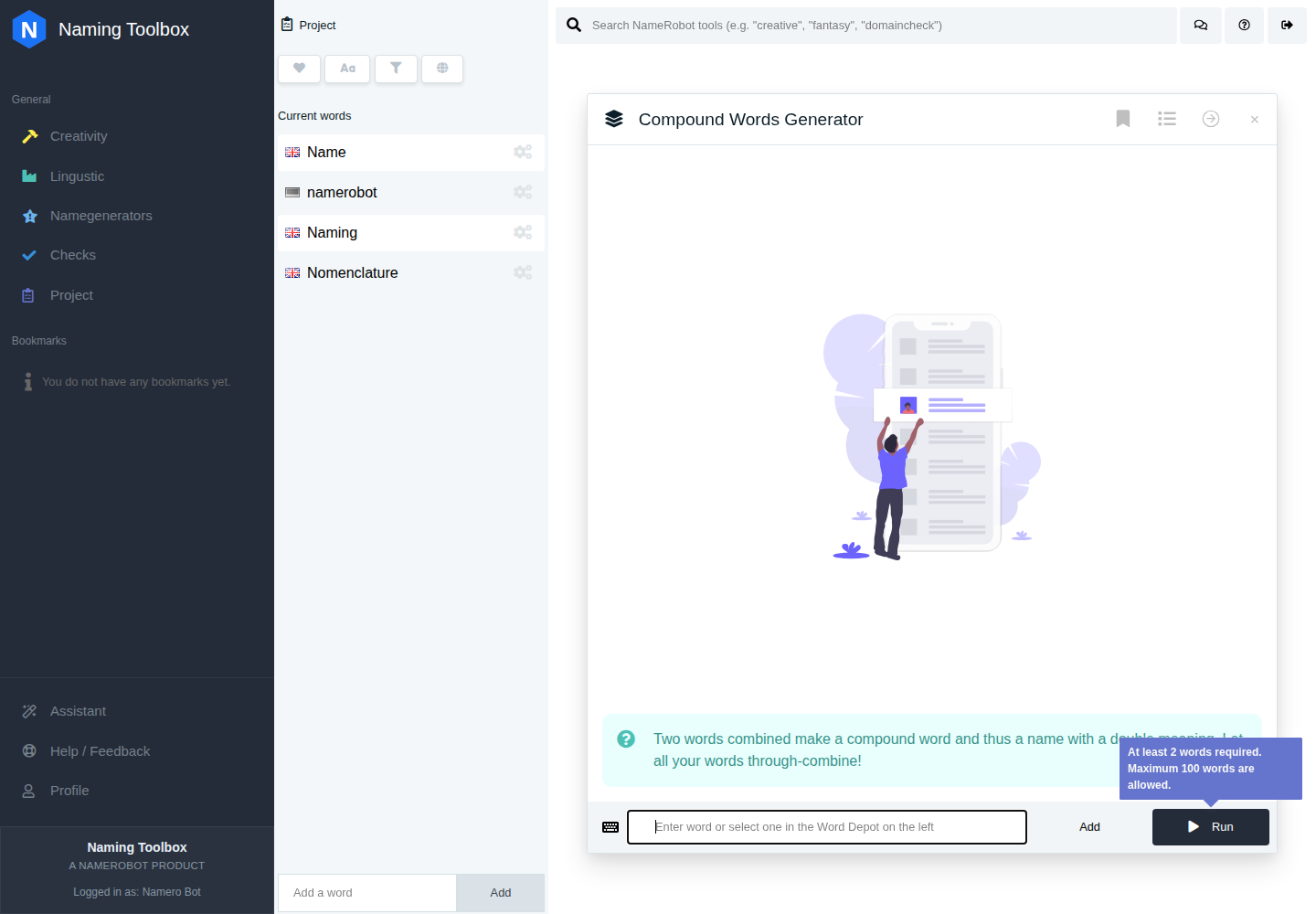
What the Tool Does
Compound Words Generator bundles several word-combination approaches into one mixed result set. It can return direct compounds, grammar-adjusted compounds, and separated pairings with visible connectors.
That makes it a useful tool when you want broad combination coverage from a single run.
How to Use It
Enter several keywords directly or select them from your project. The tool then runs multiple combinator modes internally and returns a wider set of compound and pair-style names.
This is useful when you want to compare how the same concepts behave under different combination logics.
Settings
Compound Words Generator works without manual settings. You enter your keywords, run the tool, and get a broad set of combination ideas immediately.
The tool bundles several internal combinator directions in the background, including grammar-adjusted combinations, direct combinations without grammatical changes, and separator-based combinations.
This gives you broader compound exploration from one run without asking you to choose a specific combinator mode first.
The tool is useful when you want to compare several compound-building styles before narrowing your naming direction.
When to Use It
Compound Words Generator is useful for business names, product names, project names, and descriptive naming tasks where meaning clarity matters.
It is also a strong choice when you want to discover whether your concepts work best as a direct compound, a smoother grammar-based combination, or a visible paired construction.
How to Work with the Results
The results can be used as direct name ideas or as guidance toward the best combination logic. Some suggestions may already fit, while others may simply reveal whether your inputs prefer direct or adjusted compounds.
A practical workflow is to save the strongest results and then follow up with the more specific combination tool that matches the best-performing pattern.