
Word pairs
The Word pairs tool in Naming Toolbox helps you place words next to one another in different pairing directions. It is useful when you want straightforward combinations that remain transparent and readable.
This tool is especially valuable when you want to compare simple side-by-side naming patterns before moving into more transformed combinations or mergers.
Got a naming direction already? Send it through Word pairs and use the guide below to make the results more focused.
What the Tool Does
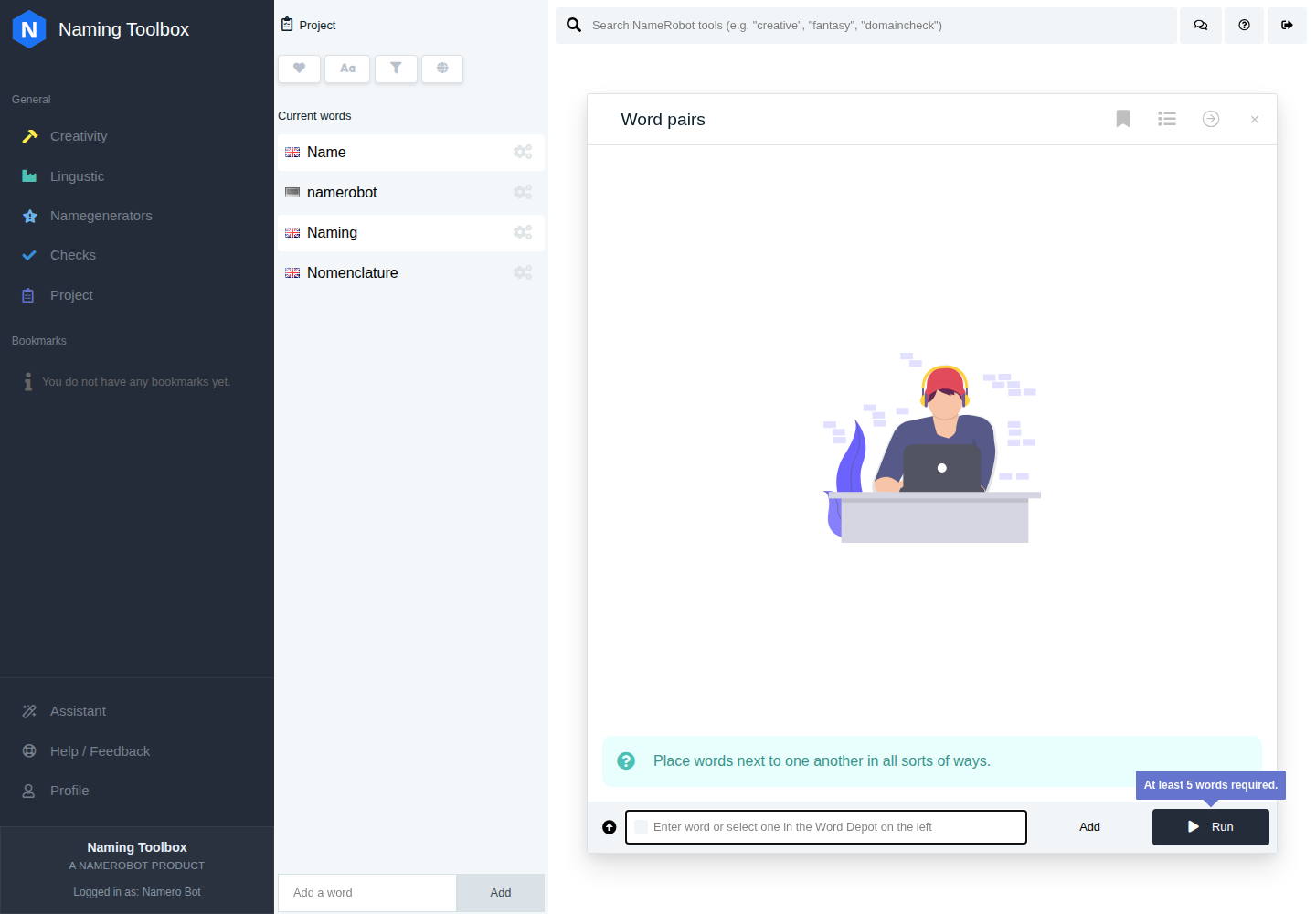
Word pairs creates paired word combinations from multiple selected inputs. The results stay relatively direct and focus more on positioning and pairing than on deeper linguistic modification.
That makes the tool useful for descriptive, understandable, and quickly testable naming ideas.
How to Use It
Enter several keywords directly or select them from your project. The tool then places the words next to one another in multiple orders and pairings.
This is useful when you want to see which word neighbors feel strongest without already committing to compound-building or word-melding.
Settings
Word pairs works without manual settings. You enter your words, run the tool, and get direct pair-style combinations immediately.
The tool focuses on placing words next to one another in simple pairing directions instead of heavily modifying them.
Because the pairing logic is fixed, it is very fast to use and keeps the results clear and easy to compare.
This makes the tool useful when you want straightforward two-word ideas before moving into stronger transformations or mergers.
When to Use It
Word pairs is useful for descriptive business names, project names, editorial names, or early-stage naming work where clarity matters more than originality.
It is also a good first step when you want to identify strong neighboring concepts before refining them further.
How to Work with the Results
The results can be used as direct name ideas or as a shortlist of promising conceptual pairings. Some may already feel strong enough to keep, while others may point to better merger or supplement directions later.
A practical workflow is to save the clearest pairings and then test whether they work better as plain pairs, merged forms, or grammar-adjusted compounds.